A Clear-Out Before Guests Arrive: Where Unwanted Things Can Go
A clear-out before guests arrive can make room without burdening charities: sort useful belongings, arrange sharing, and dispose of worn-out items responsibly.
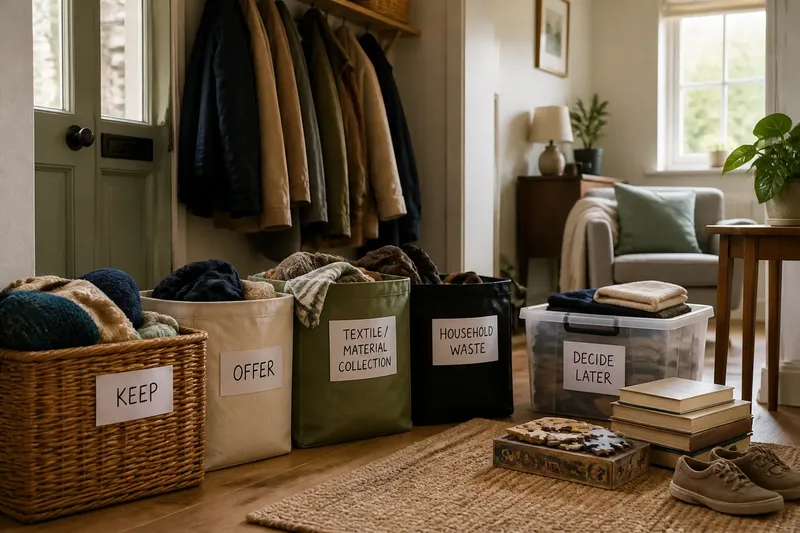
With guests due on Saturday, the crowded hall cupboard suddenly seems urgent. A clear-out before guests arrive is easier to manage when it is not treated as a race to empty the house, but as a short, deliberate route for each thing: keep, pass along, or dispose of it appropriately.
The aim is a welcoming home, not a pile of bags moved out of sight. Set a modest boundary—a single cupboard, a coat rack, or the dining table—and work through it over several days. A clear surface and a clear decision are more useful than a dramatic sweep that leaves someone else to sort your leftovers.
Choose a small area and set a finish line
Start by deciding what would make the visit more comfortable. Perhaps coats need room near the door, the spare room needs a clear chair, or the bathroom shelf should hold only what guests can use. That practical need gives the clear-out a stopping point.
Gather a few containers or mark distinct spots on the floor with paper labels: keep, offer, textile or material collection, and household waste. Add a separate place for items that need a decision later. It is better to pause over one uncertain object than to put everything into the donation pile.
Set aside short sessions across the week rather than pulling out the whole cupboard at once. A kitchen timer can help keep the work bounded, but there is no need to rush; stop when the chosen area is sorted and usable.
Sort by condition, usefulness and readiness
Handle one item at a time and ask three plain questions: Is it safe and in working order? Would someone else reasonably use it as it is? Am I prepared to pass it on now, including any cleaning or basic preparation it needs?
Things that remain useful and presentable can be offered to a person, community group or charity whose needs match them. A clean coat with working fastenings is different from one with a broken zip and missing lining. The first may be ready to wear; the second is not ready for a new owner unless a repair is made and clearly described.
Separate worn-out goods from useful ones, even if they are made of materials that can sometimes be recycled. A stained towel, cracked plastic container or incomplete game should not be presented as a donation merely because its material might have another route. Check the local council’s waste guidance or a relevant collection service for accepted items, especially where an item combines materials.
Keep items that are sentimental, seasonal, or hard to classify out of the urgent flow. Put them in a labelled “decide later” box and choose a future time to revisit it. That is a genuine decision, unlike quietly shifting the same clutter into a different cupboard.
Offer useful belongings without creating a burden
Passing something to another person works best when the recipient has a real choice. Ask before bringing a bag of children’s clothes to a friend, or send a concise message describing the item and its condition. “Would you like this?” is more considerate than arriving with a parcel that needs immediate sorting.
For a local reuse group or charity shop, check what it currently accepts and how it wants items delivered. Some places may welcome clean books but not bulky furniture; others may have limited capacity or specific opening arrangements. If an organisation cannot take something, treat that as useful information, not an invitation to leave it outside.
Prepare only what the next person needs to assess it. Pair shoes, keep a board game’s pieces together, and include essential instructions for a small appliance if they are available. For electrical goods, do not offer an item that is damaged, unsafe, or of uncertain condition as though it were ready to use.
Say you find a sturdy side table while clearing the spare room. You wipe it down, notice a wobble, and decide not to advertise it as ready; instead, you ask a neighbour who enjoys small repairs whether they want it, describing the wobble plainly. If they decline, you can look for an appropriate reuse route or follow local disposal guidance, rather than leaving the problem for a stranger.
Use the week to give each category a clear route
Several days before the visit: Choose the area and the guest-related goal. Put containers in place, then collect obvious belongings that are out of use. Do not begin with drawers full of mixed objects; a defined shelf or hook is easier to finish.
Midweek: Check condition and sort items that are genuinely usable. Message likely recipients or contact local organisations with specific questions. Keep offered items together and set a reasonable point at which you will stop waiting for a reply.
The day before: Make the room ready for guests. Move accepted items to the agreed handover point, and take only the waste or recycling that belongs in the collection route you have checked. Leave pending offers in a contained, labelled place rather than scattering them around the home.
After the visit: Follow through on anything still waiting. Renew an offer only if it remains appropriate, then use a suitable reuse, repair, recycling or disposal route. A clear-out is finished when the next action is settled, not simply when the hallway looks bare.
What should you do with items that are not quite usable?
Should damaged belongings go to a charity shop?
Usually, offer only items that are clean, safe and usable in their current condition, unless the organisation explicitly accepts repairable goods. Contact it first about anything damaged, incomplete or difficult to handle.
Can you leave donations outside a collection point?
Do not leave bags or furniture where they may get wet, obstruct access, or become a dumping problem. Use the organisation’s stated drop-off method and timing, or choose another appropriate route.
What can you do with awkward or bulky items?
Ask a relevant reuse group or local authority what it accepts and how it handles collection or drop-off. If an item is unsuitable for reuse, follow the local rules for bulky waste rather than passing the disposal task to an unsuspecting recipient.
How do you handle an item whose condition is uncertain?
Keep it out of the offer pile until you can assess it or get suitable advice. For electrical, children’s or other safety-sensitive goods, do not pass it along if you cannot establish that it is safe to use.
Make the guest space feel ready without hiding the sorting
Once the routes are clear, return the things you are keeping to their proper places and leave the guest area easy to use. A small basket for everyday odds and ends can work like a tray on a kitchen counter: it gathers loose objects without pretending they have disappeared. Empty it later, when you can decide where those objects belong.
Keep the “offer” container closed and labelled, and do not let it become a permanent holding zone. If no recipient or organisation can take an item, choose the next sensible route instead of storing it indefinitely under the name of future generosity.
A clear-out before guests arrive can make a home calmer while respecting the people and services that might receive its unwanted belongings. The useful habit is to decide what each item is ready for, then act on that decision; a few well-matched handovers are better than a crowded donation bag.
One final check helps: look at the space from a guest’s point of view, then look at the remaining bags from a recipient’s. If the first view feels welcoming and the second contains only things another person could genuinely use, the clear-out has done its job.