What Changes When Paper Gets Wet?
What changes when paper gets wet? Learn why fibres swell, sheets wrinkle and strength fades, so you can judge damp paper and choose a careful next move.
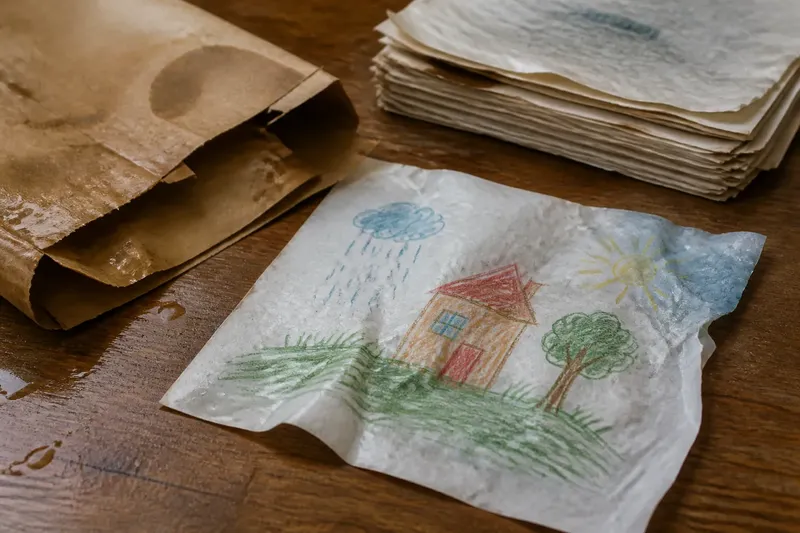
What changes when paper gets wet? A damp envelope that has gone soft at the corners shows the answer quickly: its fibres take up water, shift against one another and no longer hold the sheet as firmly together. That small change explains why paper wrinkles, tears more readily or dries into an uneven shape.
Water loosens the bonds between fibres
Most ordinary paper is made from plant fibres pressed together into a thin mat. The fibres touch and interlock, with bonds between them helping the sheet behave as one piece. Water moves into the fibres and weakens some of those bonds, so the network can flex and slide more easily.
This does not mean each fibre dissolves as soon as it gets wet. The sheet’s change in behaviour comes largely from the connections between fibres becoming less effective while moisture is present. A wet page may therefore feel limp even though its basic material is still there.
Paper behaves a little like a stack of playing cards: each piece can move against its neighbour if the grip between them loosens. Unlike cards, paper fibres are tangled together, but the comparison helps explain why a sheet can lose cohesion without coming apart at once.
Uneven wetting makes a sheet buckle
A sheet does not always absorb water evenly. A splash, damp hand or wet patch on a table affects one area before the rest, and fibres in that area swell and shift while surrounding fibres remain comparatively dry. The mismatch creates tension across the sheet, which can show up as ripples, curled edges or a raised crease.
When the sheet dries, the fibres settle again, but they may not return to their former arrangement. The resulting wrinkles are not simply water sitting on the surface; they reflect a changed pattern in the paper’s structure. A slow, even dampening can produce a different surface from a sudden local spill because the moisture reaches the sheet differently.
Coatings and finishes also affect what happens first. Some paper surfaces repel water briefly, while others absorb it quickly. A glossy finish may resist a splash on top but still be vulnerable at an exposed edge, torn corner or uncoated reverse.
Wet paper loses strength before it falls apart
Dry paper can often carry a light load or withstand a careful turn because its fibre network shares the strain. Once wet, the weakened contacts make the sheet easier to stretch, distort or tear. A page can remain in one piece yet fail at a fold or tear when lifted by a single corner.
How much strength remains depends on the paper and the kind of wetting. Thin tissue, a printed leaflet, a paper towel and a sheet designed for drawing do not respond alike. Fibre composition, surface treatment, thickness and the way the paper was made all influence how quickly it absorbs water and how well it holds together.
Repeated wetting and drying can leave paper more fragile or distorted, especially if it is handled while softened. For ordinary household paper, the useful distinction is not “wet” versus “ruined”, but whether the sheet still holds together for its intended task. A softened paper bag may be unsuitable for carrying objects even when it looks mostly intact.
Drying can preserve shape but not restore every quality
If a useful sheet becomes damp, avoid pulling it flat by force. Support it across a broad surface and let it dry without extra handling; pressing or rubbing while the fibres are softened can stretch the sheet or disturb ink and surface coatings. For a small, non-valuable item, gentle air circulation is usually less disruptive than direct heat.
Paper that matters for sentimental, archival or official reasons needs more care than a scrap of wrapping paper. If it is badly soaked, mouldy or carrying important writing, seek advice from a conservator or an appropriate specialist rather than experimenting with household heat or cleaning products. Different inks, coatings and paper types can react differently.
Say a school drawing gets splashed on one edge. If you lift it by the dry corner, the softened area may sag and tear; if you support the whole sheet on a clean, flat surface and leave it undisturbed to air-dry, it may remain usable, though a ripple or mark could remain. The expected observable difference is less strain during drying, not a return to an untouched surface.
Paper choices reflect different relationships with water
Paper intended for kitchens or cleaning is often designed to absorb liquid, while paper used for maps, labels or packaging may be coated or treated to resist it. Those properties serve different purposes: absorbency helps a towel take up a spill, while a moisture-resistant surface can help a label stay legible. Neither makes paper universally waterproof.
For a household decision, match the material to the likely contact rather than assuming a thicker sheet will solve everything. A thicker uncoated paper can still soak through; a thin coated paper may resist a brief splash but fail at a cut edge. Where a label or product specifies a use, follow that guidance because construction varies.
What do people ask about wet paper?
Why does paper wrinkle when it dries?
Moisture makes fibres swell and move, often unevenly across the sheet. As the paper dries, the fibres settle in a changed arrangement, leaving ridges or curls rather than the original flat surface.
Can wet paper become strong again?
Drying removes moisture, but it does not necessarily restore every bond or the sheet’s original shape. If fibres have shifted, torn or stretched, the paper may remain weaker or more distorted than before.
Why does paper tear more easily when wet?
Water weakens the connections that help fibres share force across the sheet. A damp page can therefore pull apart under handling that dry paper would withstand, particularly at a fold, edge or existing tear.
Is coated paper waterproof?
A coating may slow absorption or resist a brief splash, but exposed edges and damaged areas can still take in water. Treat “water-resistant” as limited protection, not proof that the paper can stay wet or be submerged.
Judge the sheet by what it must do
Understanding what changes when paper gets wet helps separate a temporary change in feel from a lasting change in usefulness. A damp sheet may dry into a workable note, while a softened bag or weakened label may no longer suit its purpose. The simplest check is to consider where the paper is wet, whether it must carry weight or remain legible, and whether gentle handling can protect what remains.
When paper is no longer fit for its original job, its next use should suit its condition: a marked sheet can still serve for rough notes, while clean, dry paper may be suitable for recycling according to local collection rules. Moisture changes the material, but it does not decide by itself that the sheet has no value.