Why a Refillable Jar Can Outlast Its First Job
A refillable jar can serve beyond its original contents when its material, opening and condition suit the next job, with clear limits on safe reuse.
Can a refillable jar safely hold something other than the food or product it came with? Often, but a jar earns another job through a good match between its shape, material and condition—not simply because it can be washed. A broad-mouthed glass jar may be useful for dry pantry goods, while a cracked one belongs out of circulation.
What makes a jar suitable for a second use?
Start with the jar itself, not the cleverest use you can imagine for it. Check the rim for chips, the body for cracks, and the base for signs of damage. Look closely around the shoulder, where the sides narrow towards the opening; residue can linger there, and a crack may be less obvious than it is on a flat wall.
Then consider what the jar must do in its new role. A jar for storing dry lentils needs a clean interior, a stable base and an opening wide enough to fill and empty without fuss. A jar intended to hold a toothbrush needs a base that will not tip easily and a mouth that is comfortable to reach into.
Think of a jar like a shoe: being intact does not mean it suits every occasion. Its original purpose tells you something about its design, but not everything. A narrow neck, fragile decorative coating or awkward lid can limit useful second jobs even when the glass is sound.
Glass is generally easy to inspect and clean, but not all jars are alike. Some have thin walls; others are shaped for a particular lid or product. Metal lids may rust, warp or lose their seal, and a lid from one jar may not fit another. Keep the jar and its own lid together if they remain sound, but do not assume a tight-looking fit is airtight.
Which second uses suit a jar’s shape and material?
Match the opening, depth and stability to the task. A wide opening gives a hand or scoop room to reach inside. A tall, narrow jar can corral pencils, but may be poor for items that need frequent retrieval. A shallow jar works for small, visible things; it offers less protection from dust than a closed container.
Common household uses include:
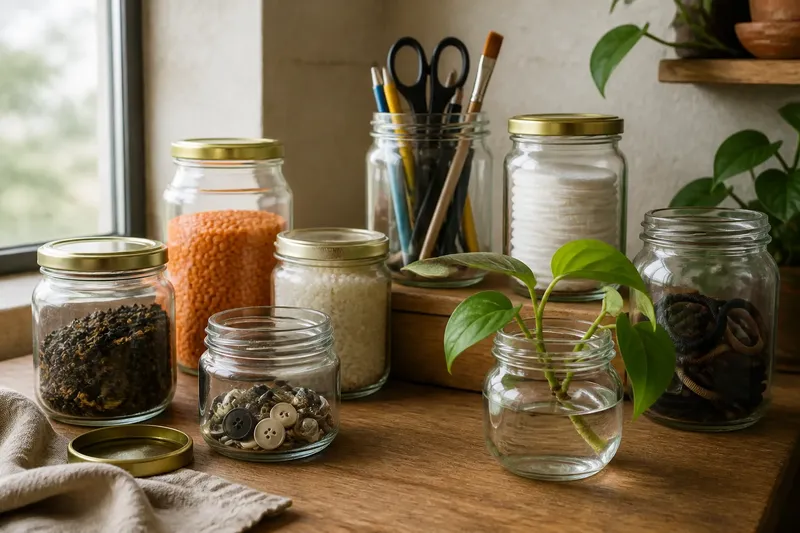
- Dry pantry storage: choose a clean, dry jar with a sound lid, and use it for ingredients that fit through the opening.
- Small-item sorting: keep buttons, spare keys or drawing pins in a jar that is stable and easy to label.
- Desk storage: use a wide, steady jar for pens, clips or paintbrushes, keeping sharp ends from pressing against the glass.
- Bathroom storage: a jar can hold cotton pads or hair ties if it stays dry and is placed where it cannot be knocked onto a hard floor.
- Plant cuttings: a clear jar can hold water and a cutting for observation, provided it is kept somewhere stable and refreshed as needed.
These are possibilities, not universal recommendations. Food storage calls for particular care: use only jars and closures suitable for the food and storage conditions involved. Reusing a jar for home-preserved food, hot liquids or other demanding purposes requires appropriate equipment and methods; a household jar is not automatically a preserving jar.
Imagine you finish a jar of apricot jam and want a place for loose tea bags. If the glass and rim are intact, the jar is thoroughly cleaned and dried, and the tea bags fit without being crushed, that is a sensible match. If the old lid smells of jam or no longer sits properly, the jar may still serve as an open desk pot, but it should not be treated as sealed storage.
How should a jar be cleaned before reuse?
Wash it with warm water and washing-up liquid, paying attention to the rim, threads and base. A bottle brush can reach the inside of a narrow jar; for a wide one, a clean cloth or sponge is usually easier to manoeuvre. Rinse until no soap or residue remains, then let the jar dry fully before adding anything that could be affected by moisture.
Check the lid separately. Remove any loose residue from its threads and inspect the inner lining for peeling, rust, persistent odour or damage. A lid that is clean but no longer closes reliably may be kept for a decorative or open-container use, but it should not be relied on to protect contents from air or spills.
Odour and staining can be clues that a jar is not suited to its next use. Persistent scent from strongly flavoured contents may be unwelcome beside tea, spices or toiletries. If washing does not resolve it, choose a second use where the smell will not matter, or put the jar aside rather than transferring the problem to its contents.
Do not use harsh cleaning methods simply to rescue a jar. Heat can stress glass that is not intended for sudden temperature changes, and abrasive scrubbing can damage printed surfaces or coatings. Follow the jar maker’s instructions where available; for food preservation, hot contents, specialist products or local disposal requirements, the relevant manufacturer guidance or local rules should decide the matter.
When is a jar no longer worth keeping?
Retire a jar from use if it has a crack, a sharp chip or a damaged rim. A small defect can make handling unpleasant and can worsen with ordinary knocks. Do not cover a chip with tape or place the jar where someone might mistake it for an undamaged container.
Other limits are less dramatic but still useful to recognise. A lid that is badly rusted, a container that remains unpleasantly odorous, or a shape that makes cleaning difficult may rule out some uses. If the jar is awkward to store or repeatedly gets in the way, keeping it indefinitely does not make it more useful.
There is a difference between keeping a jar in circulation and assigning it a job at any cost. If there is no suitable use at home, ask whether someone nearby wants it, following their preferences rather than passing along a questionable container. If it is damaged, check local recycling guidance: glass types and lids may be handled differently, so separate materials only as directed.
Can you reuse a jar for food, candles or plants?
Can a household jar store dry food?
It can be a reasonable option if the jar is clean, completely dry and made for food contact, and if the closure suits the storage need. Keep the contents within easy reach and label them clearly when confusion is possible. Do not assume that a used lid provides a reliable airtight seal.
Can I use a jar as a candle holder?
A jar’s ability to hold a candle depends on its design and the candle’s instructions, so an ordinary food jar should not be assumed safe for burning. Glass can become hot or break under uneven heating, while a narrow opening can make a flame harder to monitor. If the candle maker does not specify a suitable holder, choose one intended for that candle instead.
Is a jar suitable for a plant cutting?
A clean, stable jar can hold water for a cutting if the opening supports the stem and the jar will not be easily knocked over. Keep it in a place where it will not be confused with a drinking glass, and change the water as appropriate for the plant. A jar with a narrow neck may be difficult to clean once roots have grown.
Can jars go in the freezer or microwave?
Do not assume an ordinary jar is suitable for either. Freezing can stress glass as contents expand, while microwaving can cause uneven heating or interact badly with metal lids and decorative features. Use only containers explicitly intended for the appliance and follow their instructions.
How can a second job last beyond one tidy-up?
Give the jar a clear place and purpose. A small label can say “buttons” or “tea bags”, while a shelf position can keep frequently used jars within reach and rarely used ones from crowding the cupboard. Remove the label before the jar changes hands or holds something with a different identity.
Keep the number of jars in proportion to the tasks they actually serve. A handful of useful containers may be easier to care for than a cupboard full of possible future projects. When a jar becomes surplus, offer it for a specific use—such as dry storage—rather than asking another person to work out what to do with it.
A refillable jar can outlast its first job when its next role respects what it is: a particular container with a particular opening, closure and condition. Before keeping one, name the task, check the parts that task depends on, and decide where it will live. That modest decision is what turns an empty jar into a useful one, rather than another object waiting for a purpose.